How Much Does Trenching Cost per Foot for Utility Lines?
Last updated: September 10, 2026
Key Takeaways
- In the U.S., that usually means calling 811 before digging so underground public utilities can be marked.
- Call 811 and wait for the marks before any machine work.
- The correct alternative is to call 811 first and wait for marks.
- On a 100-foot trench, setup time spreads out and the per-foot cost may drop compared with a 20-foot trench.
For utility lines, trenching itself usually lands in the low single digits to low tens of dollars per foot. Once you fold in marking, backfill, bedding, restoration, permits, and the utility line being installed, the total climbs a lot faster than people expect. How much does trenching cost per foot utility lines? That number swings hard with depth, soil, obstructions, and surface restoration, so I’d treat any quote that skips those items as incomplete and ask a qualified contractor to look it over. According to HomeGuide and Angi cost guides, the trenching-only portion is often quoted separately from the full installed price.
What this price question really covers
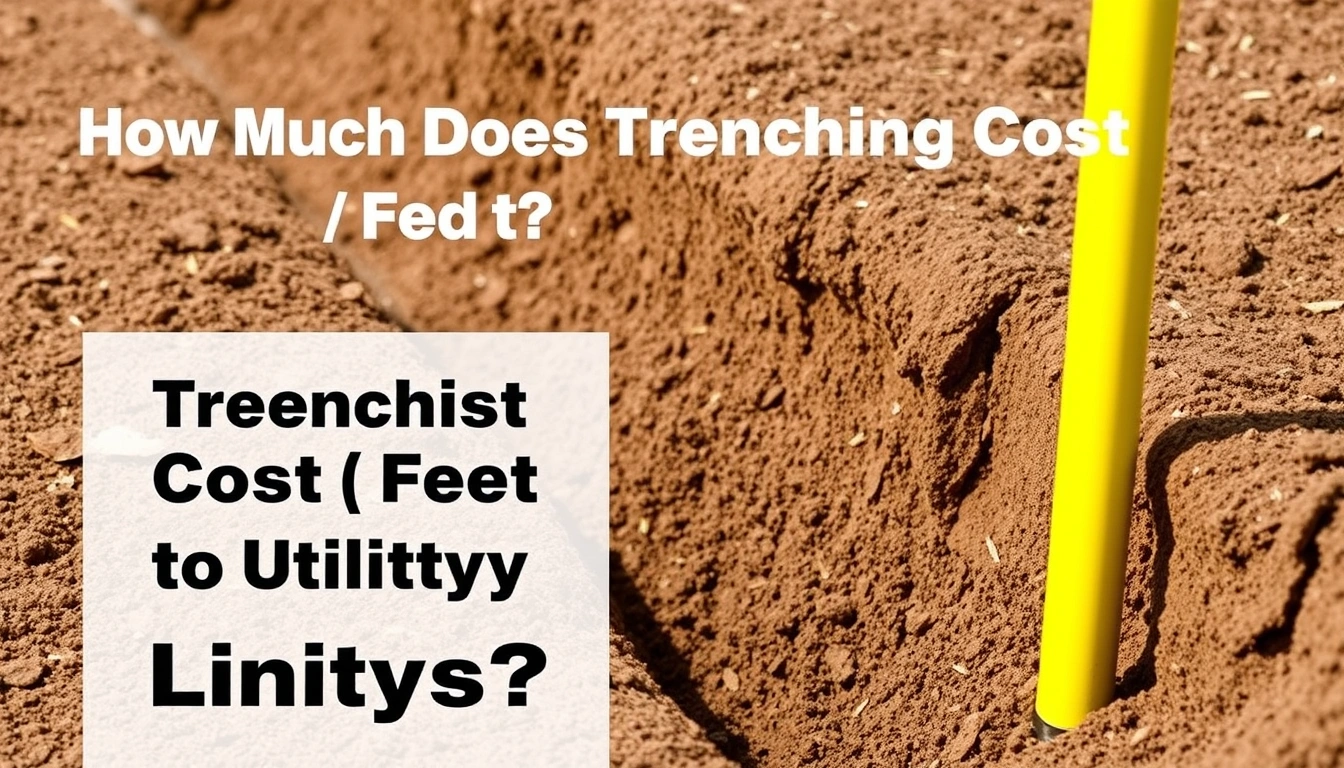
This answer applies to homeowners, builders, and small property owners who need a narrow trench for buried utilities such as electrical conduit, water service, gas line, sewer lateral, fiber, or irrigation. It assumes you already know the route, the approximate length, and the utility type — or at least that you can get those from a utility contractor or designer before work starts. Asking how much does trenching cost per foot utility lines? The useful figure is the one tied to your route, not a generic average.
I’m not treating this like a landscaping chore. Utility trenching is civil and utility work, not just “dig a ditch.” If you’re wondering how much does trenching cost per foot utility lines, a qualified utility contractor should confirm trench width, depth, bedding, and code requirements before you compare bids. The price changes because the trench may need a specific width, a minimum depth, a warning tape layer, a bedding material such as sand, or a licensed installer for gas or electrical work. An 18-inch-deep, 6-inch-wide trench is a different animal from a 48-inch-deep run that crosses asphalt and a tree root zone.
If you only care about moving dirt, that’s one number. If you want a finished utility run that passes inspection and gets restored, that’s another. I’d say the first helps with rough budgeting; the second is the one that matters when you’re actually writing a check.
How much does trenching for utility lines cost per foot?
How much does trenching cost per foot utility lines? The trenching portion alone is often priced by the linear foot, but the final installed cost per foot is usually several times higher than the digging price. For a straightforward open-yard trench in easy soil, the digging may be quoted at a modest per-foot rate; once you add pipe or conduit, bedding, backfill, compaction, and surface repair, the total climbs quickly. It’s a classic sticker shock moment.
A generic article gets this wrong by pretending “per foot” means one universal figure. It doesn’t. A contractor may quote by the foot, by the hour, or as a lump sum. The number often shifts after a site walk because underground conditions set the price: clay, rock, buried concrete, tree roots, existing utilities, or the need to hand-dig near marked lines. HomeAdvisor and This Old House both note that site conditions can shift the price materially.
The three biggest drivers are depth, access, and restoration. Depth matters because a deeper trench takes more machine time and more spoil handling. Access matters because a tight side yard, fence opening, or driveway crossing slows the job. Restoration matters because cutting and repairing sod is one thing; removing and replacing concrete or asphalt is another. A 50-foot trench through lawn is not priced like a 50-foot trench under a driveway.
Want the quote to make sense? Ask whether it includes utility locate, machine excavation, hand exposure at crossings, bedding, pipe setting, warning tape, backfill, compaction, and final grading. If the answer is no, you are not looking at a complete per-foot price; you’re looking at a partial one.
What has to be included in the number?
The number has to include more than backhoe time if you want it to be real. A complete utility trench budget usually has seven pieces: locate marks, excavation, spoil removal, trench support or hand work near hazards, bedding, the utility line itself, and restoration.
Start with utility locating. In the U.S., that usually means calling 811 before digging so underground public utilities can be marked. That service is often free, but it affects timing because marks can take a few days to arrive, and the contractor may need to hand-dig within a tolerance zone around those marks. I would never price trenching without allowing for that delay. The Common Ground Alliance says line strikes remain a serious safety issue, which is why the locate step matters.
Next comes excavation. The excavator may be a mini-excavator, a walk-behind trencher, or hand digging. Narrow, shallow runs in soft soil are much cheaper than deep or rocky ones. Spoil removal matters too: if the dirt can be stockpiled on-site, costs stay lower. If it has to be hauled away, the price rises.
Bedding and backfill are easy to ignore and expensive to omit. Bedding is the material placed under and sometimes around the pipe or conduit to protect it from stones and uneven support. Backfill must often be compacted in lifts, which means placing soil in layers and tamping each layer so the trench does not settle later. Poor compaction can leave a sunken strip in a lawn or a dip along a driveway edge.
If the line is electrical, gas, or a sewer lateral, code-specific rules may control the trench dimensions and the final inspection. The National Electrical Code, published by NFPA, and local plumbing or gas codes often set minimum cover and separation distances. That turns the job from “digging” into “building to code.”
How is trenching priced per foot, step by step?
How much does trenching cost per foot utility lines? Trenching is priced by measuring the route, turning that route into trench dimensions, and then adding the site-specific costs that the foot price hides. The most honest estimate comes from a contractor who has walked the route and knows the depth, soil, and restoration requirements.
- Mark the route on the ground. Measure the run in feet and note every turn, crossing, and change in surface type. Check that the route matches the utility plan or fixture locations. A warning sign is a path that crosses driveways, retaining walls, or mature roots without a clear reason.
- Confirm utility locates and setback needs. Call 811 and wait for the marks before any machine work. Check that public utilities are marked and that the contractor knows the tolerance zone around each mark. A warning sign is anyone proposing to trench within marked utility areas without hand exposure.
- Set trench dimensions. Record width and depth for the specific utility: for example, 18 inches deep for a shallow irrigation line is not the same as 30 to 48 inches for other utilities, depending on local code and utility type. Check the required cover from the relevant code or permit. A warning sign is a “one depth fits all” approach.
- Choose the excavation method. Decide between a mechanical trencher, mini-excavator, or hand digging for tight or hazardous spots. Check that the machine fits access gates, side yards, and grade breaks. A warning sign is equipment that cannot fit through the access path, which adds labor and time.
- Account for spoil handling. Estimate whether excavated soil can remain on-site or must be loaded out. Check that there is room for stockpiling without blocking drainage or damage-prone surfaces. A warning sign is spoil piled against a fence, foundation, or storm drain.
- Add bedding and pipe/conduit placement. Place the specified bedding thickness and install the utility at the correct slope or depth. Check slope where gravity flow matters, such as a sewer lateral. A warning sign is a trench bottom that is uneven or full of rocks.
- Backfill and compact in lifts. Replace soil in 6- to 12-inch layers and compact each layer as required by the site. Check that the trench does not settle under foot traffic or a future slab. A warning sign is loose backfill that caves when stepped on.
- Restore the surface. Regrade soil, reset sod, patch pavement, or replace concrete as needed. Check that drainage still runs away from the structure and that the surface matches adjacent grade. A warning sign is a trench line that stays visible after the first rain.
That sequence matters because the cheapest estimate is often only step 3. In many bids, the real cost is the sum of all eight steps, and step 8 can dwarf the rest if you cross hardscape.
Why do some trench quotes look cheap and others explode?
The cheap quote usually leaves out restoration, hand work, or difficult crossings. The expensive quote often reflects what the job actually needs. If I were comparing bids, I’d look for rock excavation, driveway cutting, spoil haul-off, permits, and inspection support.
Rock is the classic budget breaker. Even a short section of ledge, cobble, or construction debris can turn machine trenching into slower excavation or chipping. Existing concrete, asphalt, and buried footings have the same effect. Tree roots do too, especially where a trench passes near a mature tree and the contractor must choose between damaging roots and rerouting the line. That’s where the budget goes sideways fast.
Depth also changes the rate. A shallow irrigation trench might be a simple machine pass. A deeper utility trench may require more caution, shoring, or a wider cut. If the trench must be deeper because of frost cover or local code, the dirt volume rises with every inch, and so does the cost.
Then there is surface restoration. A trench in lawn may be relatively modest to repair. A trench in stamped concrete, brick pavers, or an asphalt driveway is not. I’d treat any quote that says “we’ll just patch it” with suspicion unless the method is spelled out and a qualified utility contractor explains the repair scope.
When should I stop and call in a qualified utility contractor?
I would stop and bring in a qualified utility contractor whenever the trench involves gas, electrical service, sewer, deep excavation, or any crossing near unknown underground utilities. This isn’t the place to save money by guessing.
Gas line work: Gas piping has leak and code issues that make the job unsafe for trial-and-error work — hire a licensed gas contractor and require pressure testing and inspection.
Electrical service or feeder trenching: Burial depth, conduit type, and inspection rules matter — use a licensed electrician or a contractor who works to the local electrical code and permit rules.
Sewer laterals or gravity-drain lines: Slope is critical, often around 1/8 inch to 1/4 inch per foot depending on the system — if the grade is wrong, the line will not drain correctly, so bring in a plumbing contractor.
Any trench deeper than about 4 feet: Collapse risk increases sharply with depth — do not improvise; deeper excavations often require protective systems, engineered support, or a contractor trained for that work.
Crossing marked utilities: One hit on water, gas, communications, or power can shut down the project and create a hazard — hand-dig or stop until the line is positively exposed and identified.
Driveways, foundations, retaining walls, or retaining slopes: These areas can fail if undermined — reroute the trench or hire someone who can protect the structure and restore it properly.
If the job sits in the first 10 feet from a building, under a slab edge, or through a utility easement with multiple crossings, I’d step back there too. That’s where mistakes get expensive.
What are the mistakes that make trenching cost more?
The most common mistake is measuring only the distance, not the conditions. Fifty feet of clean lawn is not the same as fifty feet of fence line, roots, rocks, and a sidewalk crossing. The consequence is a quote that looks low and a final bill that is not. The correct alternative is to price by route segment, not by total length alone.
Another mistake is skipping the locate call because the trench “stays in the yard.” The consequence can be utility strikes, delays, and repair liability. The correct alternative is to call 811 first and wait for marks.
A third mistake is ignoring depth requirements. The consequence is a trench that fails inspection or leaves the line vulnerable. The correct alternative is to verify minimum cover for the exact utility before work begins.
A fourth mistake is assuming spoil can always be left on site. The consequence is blocked access, damaged turf, and extra labor to move dirt twice. The correct alternative is to plan stockpile space or pay for haul-off up front.
A fifth mistake is underestimating restoration. The consequence is a trench that settles, sinks, or leaves a scar across the yard. The correct alternative is to ask whether backfill, compaction, sod, seed, or pavement patching is included.
What if the trench is not a simple straight run?
How much does trenching cost per foot utility lines? Standard trenching changes when the route includes roots, rock, pavement, or shared utility corridors. In those cases, the cost per foot should be treated as a base rate plus problem-specific adders, not as a flat number, and a qualified contractor should confirm the final scope.
For root-heavy areas, I would expect slower digging and, sometimes, route changes to avoid major roots. Cutting large roots can destabilize trees, and that can create a problem far bigger than trench cost. For rock, a contractor may switch tools, widen the cut, or bring in breaking equipment. For paved areas, saw-cutting and patching can be the dominant cost, and the trench may no longer be the cheapest part of the project.
Long runs can also change the math. On a 100-foot trench, setup time spreads out and the per-foot cost may drop compared with a 20-foot trench. But if the long run crosses several surfaces, any savings can disappear. Curves and elevation changes do the same thing because the machine spends more time repositioning and cleaning the bottom of the trench.
What should a good quote tell you?
A good quote tells you the trench depth, approximate width, total linear feet, what surfaces are being crossed, and what is included beyond digging. It should also state whether the price covers locates, hand digging near marked utilities, bedding, backfill, compaction, haul-off, and restoration.
If the contractor gives you only a single per-foot number, ask what the number excludes. I’d want to know whether the estimate assumes easy access, dry soil, no rock, and no concrete cuts. Those assumptions are not small; they are the difference between a fair number and a misleading one.
For a utility job, a quote that mentions permit, inspection, and code compliance is usually more trustworthy than one that sounds cheap. I would rather see a longer, clearer scope than a low number with vague wording.
Common questions I hear about trenching costs
How much does trenching cost per foot for utility lines? The trenching-only price varies widely by depth, soil, access, and restoration, and the installed price is usually much higher once the utility line, bedding, backfill, and surface repair are included.